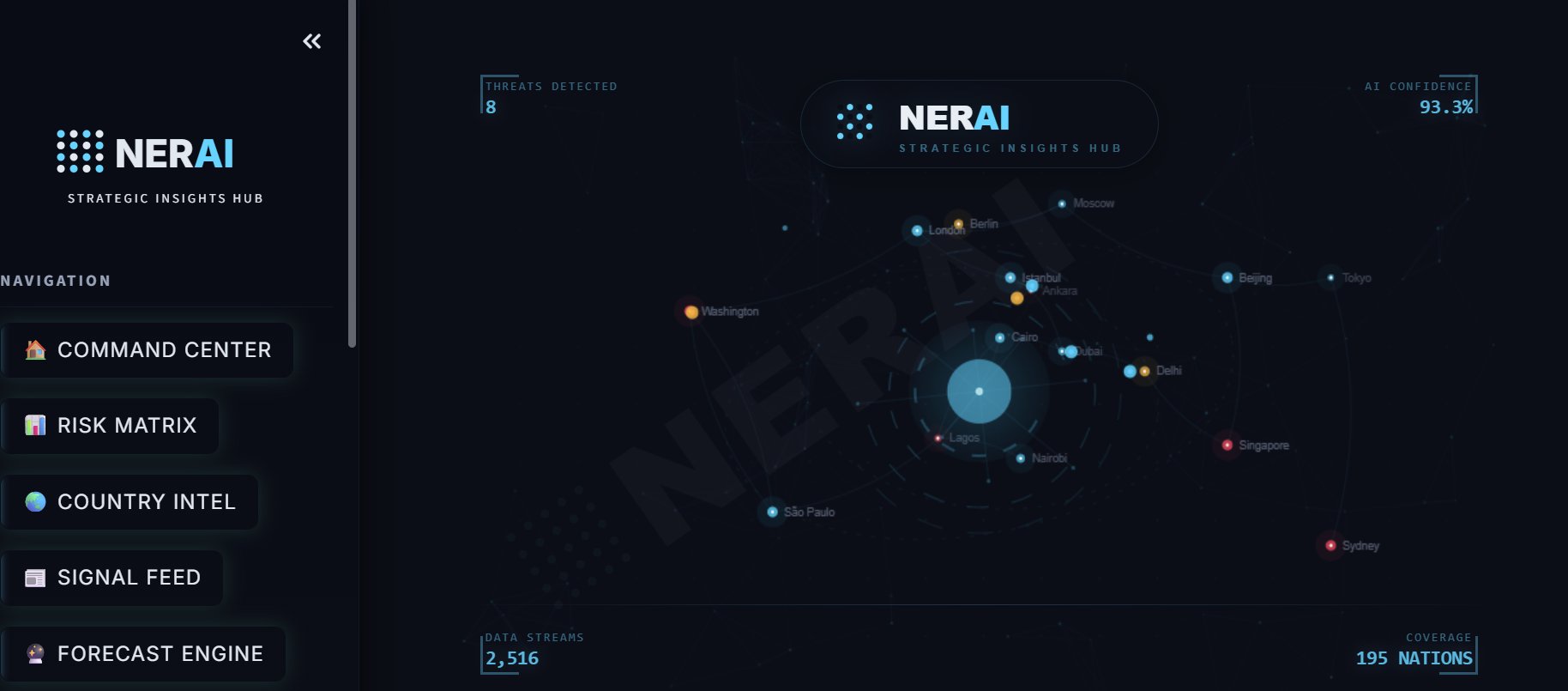
NERAI fuses millions of global event signals with AI-driven analysis to deliver decision-grade risk intelligence — quantified, forecast, and explained in plain language.
NERAI is a geopolitical risk intelligence platform built for analysts, decision-makers, and organisations that need to understand — and anticipate — political instability worldwide.
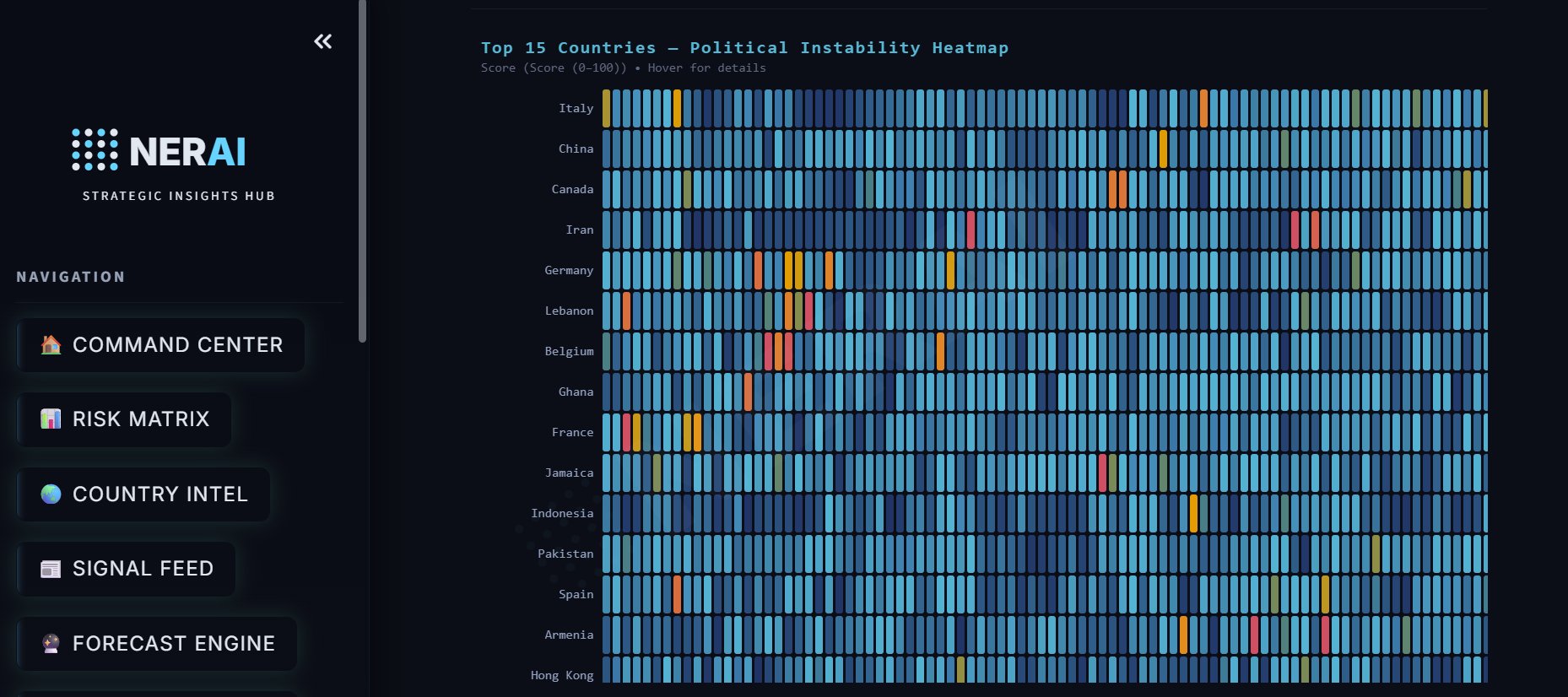
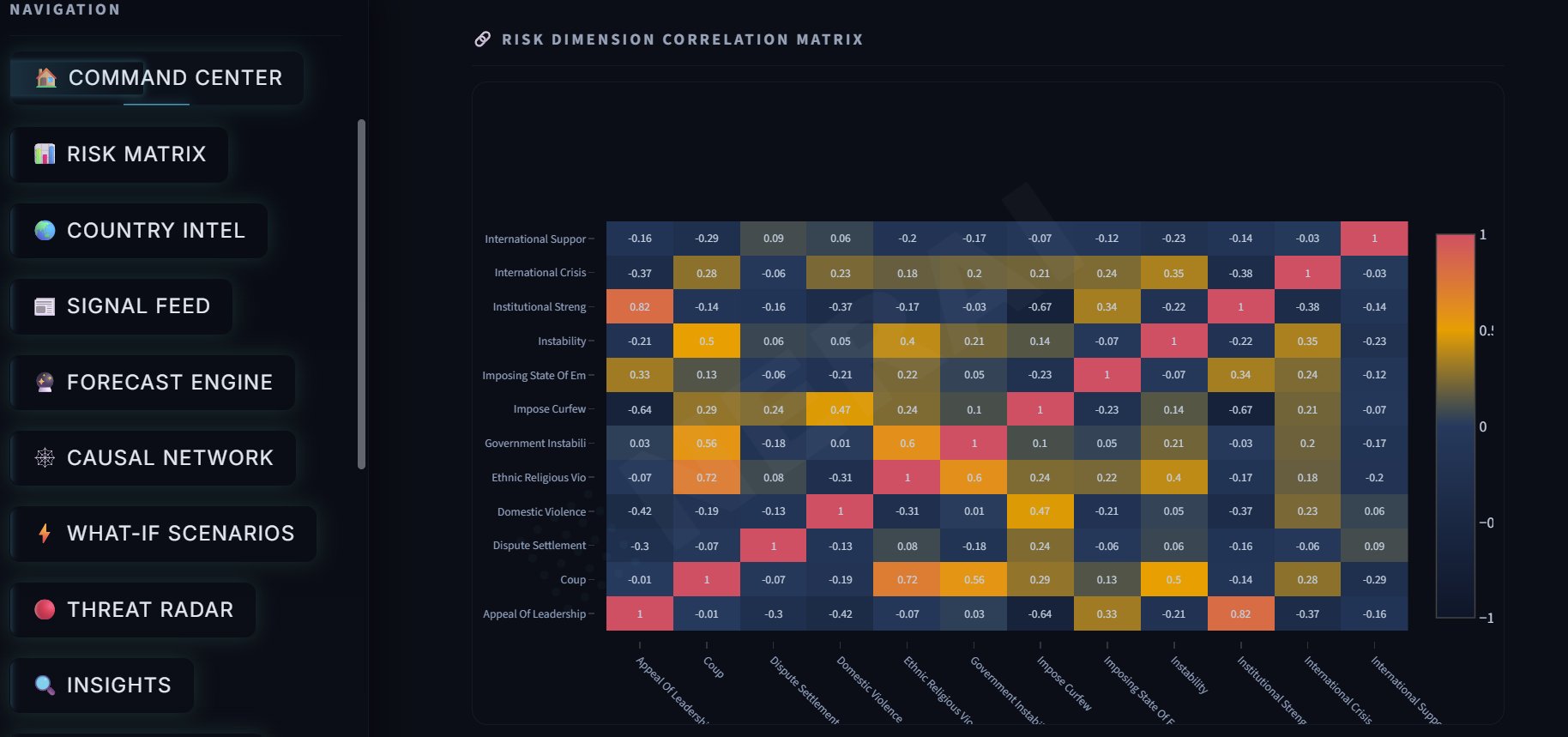
Rather than relying on subjective expert opinion, NERAI derives its signals from structured event data — millions of news articles processed daily — to produce objective, reproducible risk indices across more than 20 conflict and stability dimensions.
Every index is paired with a 12-month forward forecast, allowing users to act on emerging trends before they crystallise into crises.
The NERAI Intelligence Hub brings together every layer of analysis — from raw index trends to AI-generated risk narratives — in a clean, professional interface.
NERAI is built on open, peer-reviewed data sources and documented methodology — ensuring every index value can be traced back to its source events. There are no black boxes.
NERAI's AI Analyst combines live risk indices, 12-month forecasts, and real-time GDELT news into a single coherent answer — written at the level of a senior international relations analyst. No dashboards to navigate, no data to interpret manually. Just ask, and receive a precise, data-grounded assessment.
Iran's Military Escalation index registered a +22.4% week-on-week surge through March 26, driven by a sharp increase in GDELT-tracked confrontational events involving the IRGC and regional proxies in Iraq and Yemen. The International Crisis index rose 17.1% in parallel, the sharpest 7-day movement recorded in the past four months.
Concurrent GDELT headlines from Reuters and Al-Monitor point to renewed US carrier group deployments in the Strait of Hormuz and expanded Treasury sanctions on Iranian petrochemical networks as the primary drivers. The US Bilateral Deterioration index — which tracks adversarial event frequency between Washington and Tehran — rose +18.9%, confirming the data-to-news causal link.
The 12-month Prophet model projects Iran's Military Crisis index to rise a further +31% by February 2026, contingent on current trajectory. The US forward outlook is more contained: Political Instability indices are forecast to ease –8.4% as electoral uncertainty dissipates, though sanctions-related Economic Pressure metrics are expected to climb +14%.
Strategic outlook: The Iran–US dyad is entering its most structurally volatile phase since 2020. Analysts should watch the Strait of Hormuz shipping disruption index and Saudi bilateral indicators as leading edge signals of escalatory spillover.
Two purpose-built quantitative systems give NERAI its predictive edge — a Granger causality network that maps how risk propagates across the globe, and a scenario engine that simulates the future before it happens.
Using Granger causality testing across all 2,400+ topic × country index pairs, NERAI discovers statistically significant lead-lag relationships between risk series — revealing how instability in one region propagates to others before it becomes visible in the news.
Define any geopolitical shock — a military escalation, a leadership collapse, a sanctions wave — and the scenario engine re-runs the forecast model on the altered data, propagating the shock through the causal network to reveal second and third-order effects across connected countries.
NERAI's What-If engine lets analysts model hypothetical scenarios — "What if Iran closes the Strait of Hormuz?", "What if the Iran-Israel-US conflict draws in regional powers?", "What if ceasefire talks in Ukraine stall?" — and project the cascading impact on risk indices across interconnected countries.
Explore the Platform →7-day free trial on all plans — no credit card required to start.
Explore the live NERAI Intelligence Hub — real data, real forecasts, and real-time analysis for a world that does not wait.